Drain & sewer only — no side work
Denver Drain Cleaning, Hydro Jetting & Sewer Line Specialists
Slow drain, standing water, gurgling toilet or sewage at the floor drain — we diagnose what is actually blocking the line, clear it properly, and show you on camera why it happened. Same-day appointments throughout Denver and the surrounding metro.
- Same-day and emergency appointments
- Flat price quoted before work starts
- Licensed, insured, background-checked techs
- Camera verification on main line work
- Residential, commercial and multifamily
- Clean job site, every visit
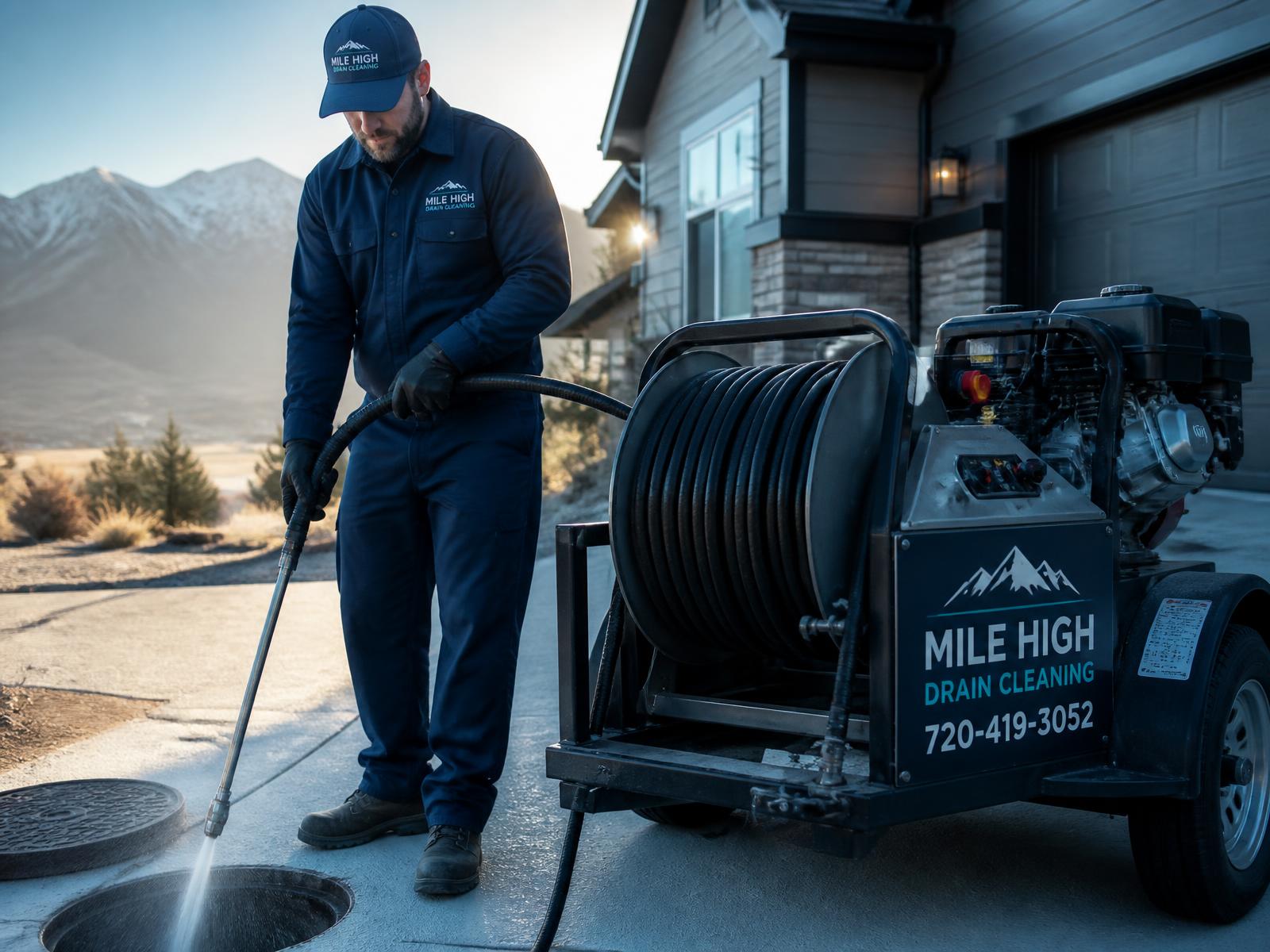
Why Denver homeowners call a drain specialist
We do one thing, and we do it with the right equipment on the truck
Most plumbing companies treat drain work as a small part of a much larger service list. A general plumber often arrives with a mid-size cable machine and nothing else, which means a grease-lined kitchen branch or a root-packed clay sewer gets a hole punched through it and the visit ends there. The drain runs again for a few weeks, then closes back down.
Our trucks carry sectional and drum cable machines, a trailer jetter and a compact electric jetter for interior work, push cameras for 2- and 3-inch branch lines, a self-leveling sewer camera with a locating sonde, and the nozzles required for grease, scale and root cutting. That matters because the right tool is decided by what the pipe contains — not by what happens to be in the van.
Diagnose before clearing
We start with how the system is behaving — which fixtures are affected, in what order, and how fast water recedes. That narrows the problem to a branch, a stack or the main before a single tool comes off the truck.
Clear the pipe, not just the plug
Restoring flow is the minimum. Removing the material lining the pipe wall is what keeps the drain open through the next season.
Show you the evidence
On main lines we run a camera afterward, mark the footage where problems sit, and give you the recording — including when the honest answer is that the pipe needs repair, not cleaning.
Emergency drain & sewer service
Active backup? Stop running water and call now.
If sewage is coming up at a floor drain, tub or basement shower, every gallon you send down the line has to go somewhere. Shut off the washing machine and dishwasher, avoid flushing, and keep people and pets out of standing water — it is contaminated. We dispatch same day across the metro, including nights and weekends.
Open 24 hours for drain emergencies · Scheduled service 7am–7pm daily
Primary service
Professional drain cleaning in Denver, Colorado
Drain cleaning covers every wastewater line inside and beneath a building: the trap arm under a bathroom sink, the 2-inch branch serving a kitchen, the vertical stack in a duplex, the floor drain in a 1920s Baker basement, and the building sewer that carries all of it to the city main under the street. Each of those has a different diameter, a different typical failure, and a different correct method.
A drain closes for one of three reasons. Something was introduced that should not have been — wipes, hygiene products, a child's toy, food scraps a disposal never actually liquefied. Something accumulated slowly on the pipe wall — grease, soap, hair, mineral scale from Denver's moderately hard water, or laundry lint. Or something entered the pipe from outside, which in this city almost always means tree roots working through a joint in old clay or cast iron.
Those three causes look identical from the sink. They are not remotely the same job. Guessing costs you a second service call; diagnosing costs you nothing extra.
- Kitchen sinks, disposals and dishwasher drains
- Bathroom sinks, tubs, showers and toilets
- Laundry standpipes and utility sinks
- Basement, garage and mechanical-room floor drains
- Branch lines, vertical stacks and vent-assisted clearing
- Main building sewers to the city tap
What we will not do
Full service list
Every drain service we provide across the Denver metro
Each service below has its own dedicated guide covering how the work is performed, what it costs and when it is the right choice.
Hydro Jetting
The right answer for grease, scale, sludge and fine root hair when cabling only punches a hole through the blockage.
Drain Snaking
Sectional and drum machines sized to the line, from 1/4-inch cable in a lavatory arm to 100 feet of main-line cable.
Main Sewer Line Cleaning
Cleanout access, root cutting, jetting and camera inspection on the building sewer between your home and the city main.
Video Camera Drain Inspection
Recorded push-camera and sewer-camera inspections with locating, footage marks and an honest read of pipe condition.
Root Intrusion Removal
Denver's mature elms, cottonwoods and silver maples find every joint. Mechanical cutting plus jetting removes the fibrous mat, not just the core.
Kitchen Drain Cleaning
The most-used drain in the house and the one most likely to close off slowly over years.
Bathroom Drain Cleaning
Hair and soap in the trap arm, hard-water scale in older galvanized branch lines.
Laundry Drain Cleaning
Lint and detergent film narrow a 2-inch standpipe until a modern high-volume washer overwhelms it.
Floor Drain Cleaning
Often the first place a main-line problem shows up, and the last drain anyone maintains.
Emergency Drain Cleaning
Sewage at a floor drain, an unusable single bathroom, or a business that cannot serve customers.
Commercial Drain Cleaning
Grease interceptor lines, shared stacks and scheduled maintenance that prevents closures.
Residential Drain Cleaning
Work sized and priced for a home, with drop cloths, shoe covers and a clean finish.
Preventive Drain Maintenance
For lines with a history: root-prone sewers, restaurant grease lines and buildings with old cast iron.
Our process
What a drain cleaning visit actually looks like
Knowing the sequence removes most of the anxiety around letting a stranger open your plumbing. Here is how a standard call runs, whether it is a single slow lavatory or a full main-line backup.
- 1
Phone triage
We ask which fixtures are affected, whether anything gurgles, whether the problem is sudden or gradual, and the age of the home. That usually predicts the cause before anyone is dispatched, and it tells us which equipment to load.
- 2
On-site inspection
The tech confirms the symptom, checks related fixtures, and finds access — a cleanout, a roof vent, a pulled toilet or the fixture trap. Floors and cabinets get covered before tools come inside.
- 3
Flat quote, then approval
You get one price for the work described, including access. If we hit something that changes scope — no cleanout where one was expected, for instance — we stop and re-quote before continuing.
- 4
Mechanical cleaning
Cable, jetter, or both, matched to the line. On grease and scale we jet, because a cable bores a channel and leaves the coating behind.
- 5
Flow testing
We run water heavily and long enough to load the line the way real use does — not a ten-second rinse. A drain that passes a token test and fails on laundry day was not fixed.
- 6
Camera and findings
On main lines and recurring problems we camera the pipe, locate anything significant, and walk you through what you are seeing in plain language, plus what maintenance interval makes sense.
- 7
Cleanup and documentation
Access points closed, area cleaned and disinfected, invoice itemized, footage delivered.
Method focus
Hydro jetting: cleaning the pipe wall, not just the opening
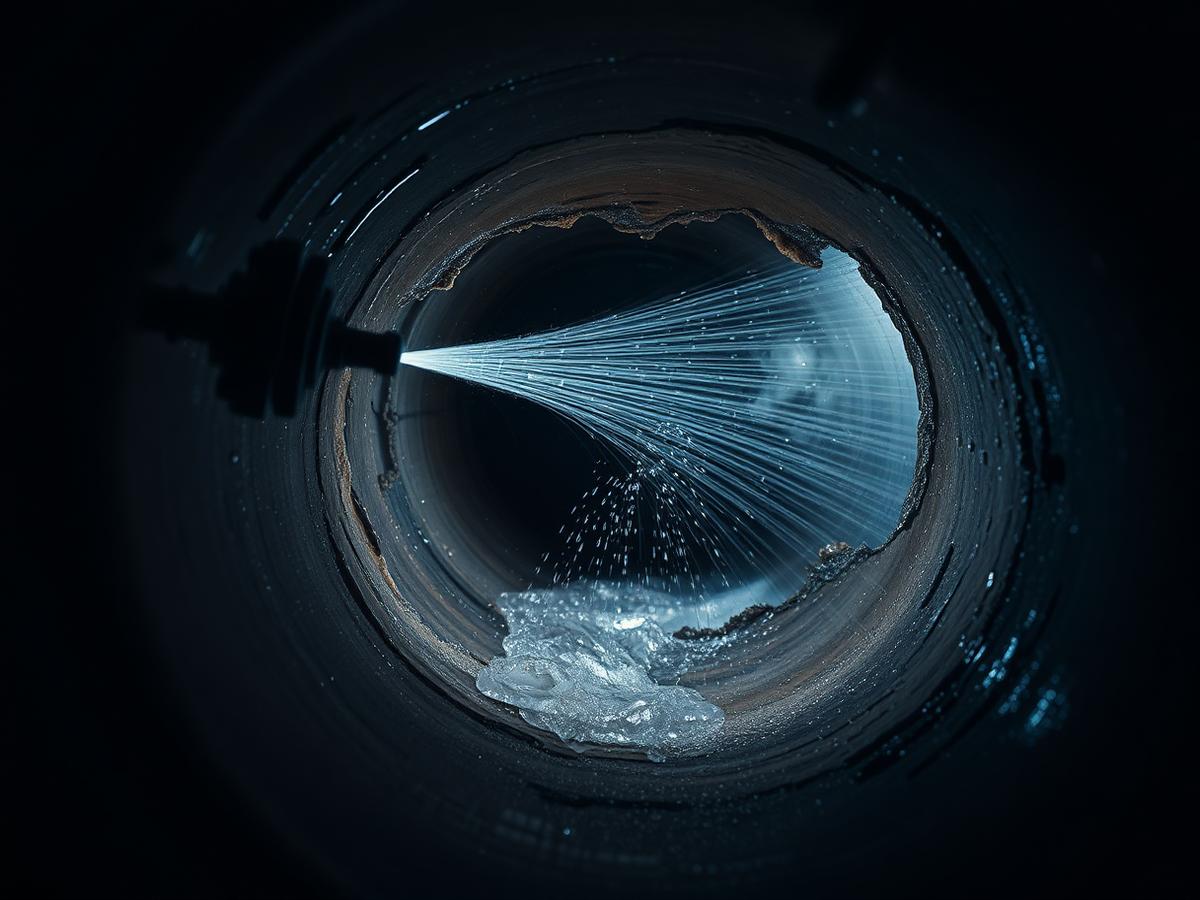
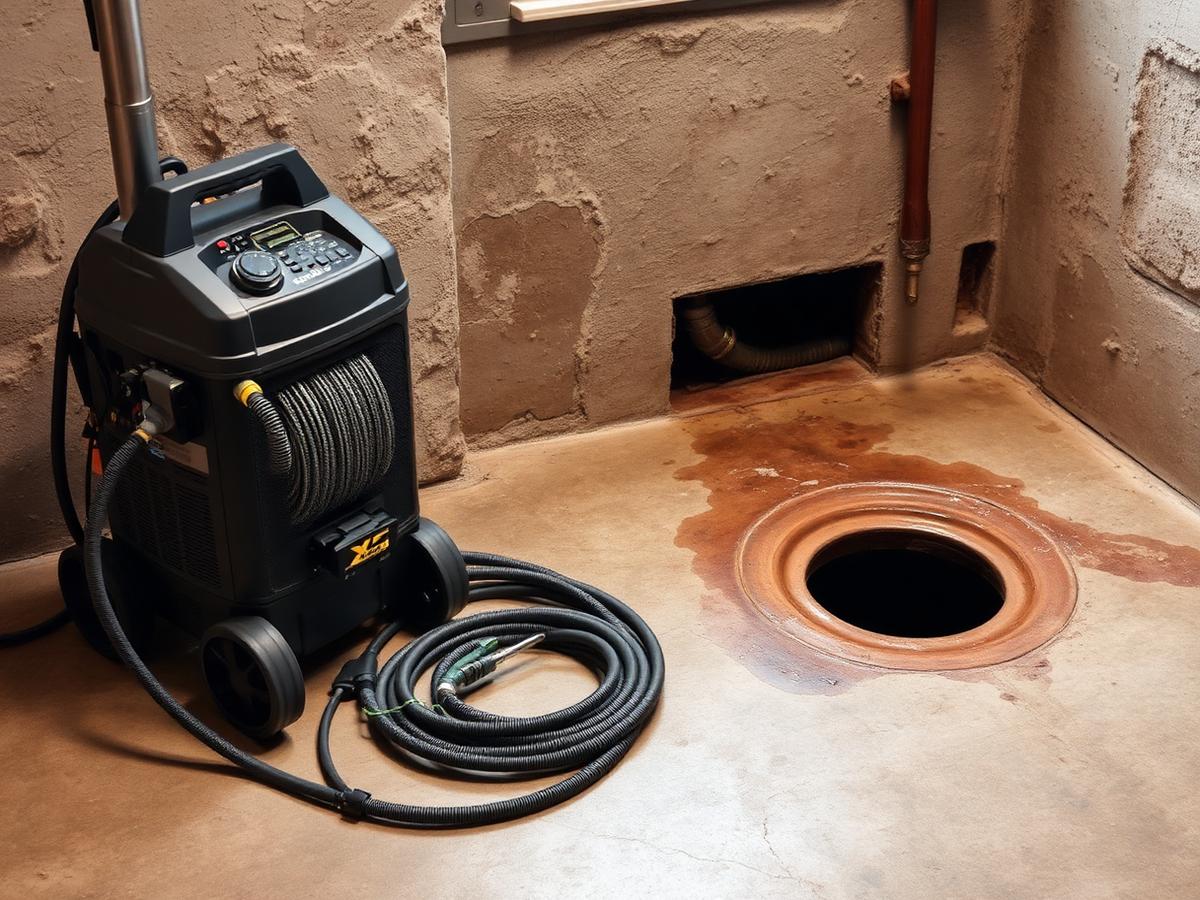
A jetter pushes water through a nozzle at 1,500 to 4,000 PSI. Rear-facing jets pull the hose upstream while scouring the full circumference; a forward jet breaks through the obstruction. The result is a pipe restored close to its original diameter, with debris flushed downstream rather than left in place.
It is the correct method for restaurant grease lines, kitchen branches with years of buildup, sand and sediment in a settled line, and fine root hair left after cutting. It is the wrong method for a badly deteriorated pipe, which is exactly why we camera first on unfamiliar lines.
Method focus
Cabling and camera work
Cable machines remain the fastest, least invasive way to open a hard stoppage: a toy in a toilet, a solid mass of hair in a tub trap, a root ball in a 4-inch sewer. Head selection is what separates competent cabling from cable-and-pray. A retrieving head recovers objects, a grease cutter shears soft buildup, and a root saw sized to the pipe removes the mat rather than drilling through the middle of it.
Camera inspection is what turns a cleared drain into a diagnosis. We record the run, note footage marks, and locate depth and position from the surface — the same information a repair contractor would otherwise charge you to gather again.
Common problems
Symptoms, and what they usually mean
Drains rarely fail without warning. They announce the problem for weeks or months first, in a language most people have not been taught to read.
| What you notice | Most likely cause | How urgent |
|---|---|---|
| One sink drains slowly | Localized buildup in the trap or trap arm — hair and soap in a bath, grease and food film in a kitchen | Low. Schedule within a few weeks before it closes completely. |
| Every fixture is slow | Restriction in the stack or the main building sewer | Moderate to high. A partial main blockage becomes a full backup with no additional warning. |
| Toilet gurgles when the tub drains | Air being pulled through the trap because the shared line is partially blocked or the vent is obstructed | Moderate. Classic pre-backup signal on a main line. |
| Water rises in the basement floor drain | The main sewer is blocked downstream; the lowest opening in the system becomes the relief point | Emergency. Stop water use and call. |
| Sewer odor indoors | Dry trap, failed wax ring, cracked vent, or biofilm in a rarely used drain | Low to moderate, but investigate — persistent odor can indicate a broken line. |
| Recurring clogs in the same drain | The underlying condition was never removed: grease coating, a belly holding water, offset joint or roots | Moderate. Camera the line rather than paying to clear it a fourth time. |
| Standing water in a yard over the sewer path | Line break or separated joint leaking wastewater into soil | High. This is a repair issue, not a cleaning issue. |
| Multiple homes on the block affected | City main issue | Call Denver Water / city wastewater as well; we can confirm whether your lateral is clear. |
Local conditions
Why Denver drains fail the way they do
Drain problems are regional. What clogs a line in Denver is not what clogs one in Houston, and the housing stock explains most of it.
Old pipe under old trees
Large parts of central Denver — Baker, Congress Park, Park Hill, Berkeley, Wash Park — were built between 1900 and 1955 with clay-tile or cast iron sewers. Clay is jointed every few feet, and the mature elms, cottonwoods and silver maples planted along those same streets send roots straight into the joints looking for moisture.
Dry climate, thirsty roots
Denver averages roughly 15 inches of precipitation a year. In a semi-arid climate a sewer line is one of the most reliable water sources in the soil, which makes root intrusion more aggressive here than in wetter regions.
Expansive clay soils
The bentonite-rich clay under much of the Front Range swells and shrinks with moisture. That movement pulls joints apart and creates bellies — low spots that hold water and collect solids. Cleaning restores flow; only repair fixes the grade.
Hard water and scale
Front Range water carries enough mineral content to build scale in older galvanized branch lines, narrowing them steadily. Jetting removes scale that a cable will simply slide past.
Freeze-thaw cycling
Denver swings across freezing hundreds of times each winter. Repeated ground movement stresses shallow lines and can widen existing joint separations.
Dense restaurant corridors
Kitchens along Colfax, South Broadway, RiNo and Federal put enormous grease load into small laterals. Those lines need a jetting schedule, not reactive cabling.
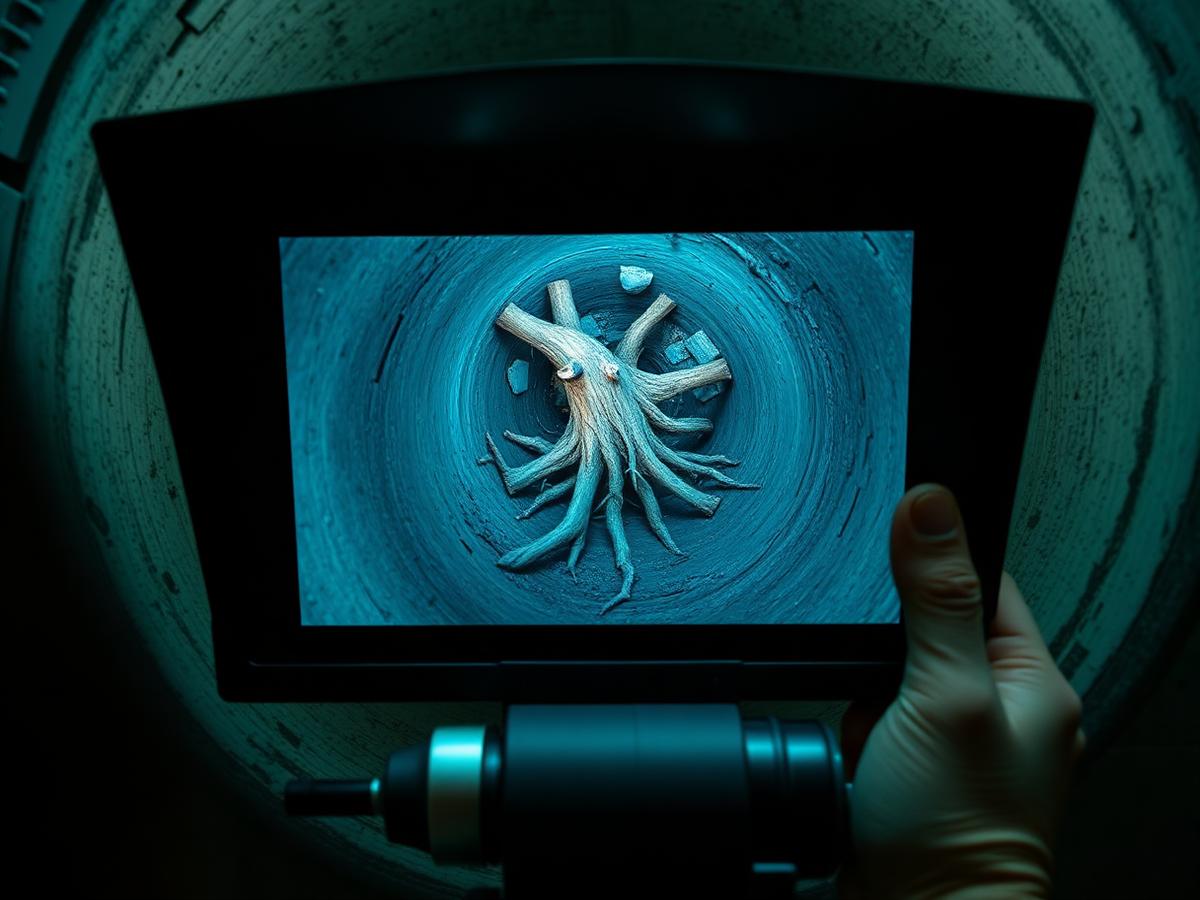
Root intrusion is the defining Denver drain problem
Roots enter as hair-fine filaments through a joint, then thicken and mat, catching paper and solids until the line closes. Cutting them restores flow immediately, but the root system outside the pipe is untouched and regrows. Jetting after cutting removes the fine residual mat and buys considerably more time. Permanent resolution means repairing or lining the pipe — until then, a known cleaning interval is a legitimate, economical strategy.
Root intrusion guide →Cleaning vs. repair
When cleaning is enough, and when it is money down the drain
Cleaning removes what is inside the pipe. It cannot correct the pipe itself. Knowing which problem you have is the difference between a $350 service call and a repeated one.
| Condition | Cleaning solves it? | What we recommend |
|---|---|---|
| Grease, soap, hair or food buildup | Yes | Cable or jet depending on severity; adjust habits and set a maintenance interval if it recurs. |
| Foreign object | Yes | Retrieval head, or camera-guided removal if it is lodged. |
| Scale in galvanized branch lines | Usually | Jetting; if the pipe is heavily corroded, replacing the branch is the better long-term spend. |
| Roots through joints | Temporarily | Cut and jet now, camera to grade the severity, then choose an interval or a repair/lining plan. |
| Belly (sagging section holding water) | No | Cleaning gives short relief. Correcting grade requires excavation of that section. |
| Offset or separated joint | No | Repair or spot liner. Continued cabling can catch and worsen the offset. |
| Cracked or collapsed pipe | No | Repair. Do not jet a compromised line. |
| Bad original slope or undersized line | No | Re-pipe the affected run; this is a design problem, not a maintenance one. |
An honest rule of thumb
Pricing
What drain cleaning costs in Denver, and what changes the number
Nobody enjoys ranges, but honest pricing requires them: the same clogged kitchen sink is a twenty-minute job in a 2010 townhome and a two-hour job in a 1912 bungalow with no cleanout and a cast iron branch. These are the ranges we actually work in across the metro.
| Service | Typical Denver range | Notes |
|---|---|---|
| Single fixture drain (sink, tub, shower) | $150 – $350 | Assumes accessible cleanout or trap access. |
| Toilet stoppage | $175 – $375 | Higher if the toilet must be pulled and reset. |
| Laundry standpipe | $175 – $350 | Lint and detergent buildup; often paired with a jetting upsell we usually decline to push. |
| Main sewer line cabling | $250 – $500 | Through an existing exterior cleanout. |
| Main line with no cleanout access | $400 – $700 | Roof vent access or pulling a toilet adds labor and risk. |
| Video camera inspection | $200 – $450 | Often waived or discounted when performed with a main line cleaning. |
| Hydro jetting — residential main | $500 – $900 | Depends on length, diameter and material volume. |
| Hydro jetting — commercial grease line | $700 – $1,800 | Scheduled maintenance contracts price lower per visit. |
| Root cutting + jetting combination | $650 – $1,400 | Includes camera verification. |
| After-hours emergency response | +$100 – $250 | Nights, weekends and holidays. |
The five things that move the price
- Access — an exterior cleanout is the cheapest path; roof vents and pulled toilets cost more
- Line length and diameter — a 4-inch, 90-foot sewer takes longer than a 2-inch branch
- What is in the pipe — hair clears fast; hardened grease and root mats do not
- Method required — jetting is a heavier setup than cabling and priced accordingly
- Timing — after-hours and holiday dispatch carry a premium
Watch for the $99 special
Maintenance & prevention
Keeping drains open between visits
Most residential drain calls are preventable, and prevention costs nothing but habit. None of the advice below is proprietary — we would rather you not need us for the avoidable ones.
Kitchen
Grease is liquid when it goes down and solid twenty feet later. Pour cooled fat into a container and trash it. Wipe pans before washing. Run cold water with the disposal — hot water carries grease further down the line before it congeals. Coffee grounds, rice, pasta and fibrous vegetable peels belong in the bin, not the disposal.
Bathroom
A $3 hair catcher in each tub and shower prevents the majority of bathroom drain calls. Nothing but human waste and toilet paper goes in a toilet — "flushable" wipes do not break down and are the single biggest cause of avoidable main line stoppages we see.
Laundry & utility
Clean the washer lint filter, and consider a mesh lint trap on the discharge hose. Pour a gallon of water into unused floor drains monthly so the trap does not dry out and let sewer gas in.
Whole-house habits
Once a week, run hot water in each fixture for a minute. Skip caustic chemical cleaners entirely. If you have a known root-prone sewer, schedule cleaning on a calendar rather than waiting for the backup — a scheduled visit is always cheaper than an emergency one plus cleanup.
Why choose us
Specialists, upfront pricing, and evidence you can keep
Drains only
We are not upselling a furnace tune-up or a water heater while we are here. The entire business is drains and sewers, which is why the equipment and the experience are both deeper than a generalist's.
Flat pricing before work
One number, quoted after we see the situation and before a tool comes out. Scope changes require your approval, not a line item you discover on the invoice.
Camera footage is yours
You keep the recording. It is your pipe, your evidence, and useful if you ever sell the property or file an insurance claim.
Licensed and insured
Fully licensed and insured for residential and commercial work in Colorado, with background-checked technicians.
Respect for the property
Drop cloths, shoe covers, contained mess, disinfected work area. Drain work is dirty; your house should not be when we leave.
Workmanship guarantee
If a line we cleared closes again within the guarantee window under normal use, we come back and make it right — the terms are written on your invoice, not buried on a website.
What customers say
Reviews from around the metro
"Main line backed up into the basement on a Sunday night. They were here in about ninety minutes, cleared roots at 42 feet, and showed me the camera run afterward so I understood what I'm dealing with long term. No pressure to buy a new sewer."
"Our kitchen line had been cabled three times by another company in two years. These guys jetted it, and the camera showed why the cabling never held — the pipe was coated in grease. A year later, still draining fine."
"We manage 40 units and needed a crew that could work early mornings without disrupting tenants. Scheduled jetting on the stacks has basically ended our emergency calls."
Service areas
Where we work
We cover Denver proper and the surrounding metro, with technicians staged so that most emergency calls are reached the same day.
Central Denver
Downtown / LoDo · Capitol Hill · Cheesman Park · Congress Park · City Park · Five Points · RiNo · Baker · Wash Park · Platt Park · Cherry Creek · Highland
North & West Denver
Berkeley · Sunnyside · Sloan's Lake · West Colfax · Regis · Globeville · Elyria-Swansea · Chaffee Park
South & East Denver
University Park · Belcaro · Hilltop · Park Hill · Virginia Village · Harvey Park · Green Valley Ranch · Stapleton / Central Park
Surrounding Metro
Aurora · Lakewood · Englewood · Littleton · Arvada · Wheat Ridge · Westminster · Thornton · Commerce City · Centennial · Golden · Broomfield
Frequently asked questions
Drain cleaning questions Denver homeowners ask
Go deeper
In-depth guides
Talk to a drain specialist, not a call center
Describe what the drain is doing and we will tell you what it likely is, what it takes to fix it, and what it costs — before a truck is dispatched.